


The magazine's editor--Lily Xia, this episode's editor--Jason Wu from Students' English Editorial Office
A journal by juniors who pay attention to the wrong things
"For those of us allergic to answers."
· · ·
MONDAY: The library's copy of The Bell Jar has a dried flower pressed between pages 64 and 65. The librarians have decided to leave it.
TUESDAY: Someone is rearranging the magazines by color, from the yellow of National Geographic to the deep red of The New Yorker. Nobody wants to know why.
WEDNESDAY: The chemistry lab's fume hood is now an art installation: a half-burnt candle, a paper crane, and a note reading “This is also chemistry.”
THURSDAY: A pigeon outside Room 204 is listening to Mr. Harrison's lecture on the Industrial Revolution. It has not blinked in forty minutes.
FRIDAY: The vending machine now dispenses two items for the price of one. The administration calls it a “mechanical anomaly.” The students call it a miracle.
SATURDAY: The janitor's closet is now, without permission, a photography darkroom.
SUNDAY: Nobody is at school. The walls, according to one especially sensitive junior, are “definitely humming.”
· · ·
By Tina, 11th Grade
For fifteen years my hair has been a rebellion against every brush, every forecast, every authority figure. My mother called it “unruly”; my grandmother, “a sign of character”; Mr. Chen, “a teachable moment.”
He once wrote on the board: “Observe the geometry of nature. A coastline. A snowflake. Tina's hair.” He was right: my hair is fractal, an equation that refuses to be solved.
“My hair was the first thing I ever had to negotiate with. Not my parents. Not my teachers. My hair.”
Eventually I made a deal with it: I stopped straightening, learned the vocabulary — leave-in conditioner, diffuser, plopping — and found the girls in the videos had curly hair too. They weren't trying to flatten it; they were trying to understand it.
What you thought was chaos is actually structure, one that doesn't apologize for taking up space. Last week Mr. Chen said, “Your hair looks particularly fractal today, Tina.” I said, “Thank you, sir. I've been working on my Koch snowflake.”
· · ·
By Sophia, 11th Grade
On the mat I have been taken down more times than I can count. I am literally on the floor, another person's weight on my chest, trying to remember the four-step escape my coach drilled into us: frame, bridge, shrimp, recover guard. I usually forget shrimp.
You spend eighty percent of your time on your back, on a mat that smells like everyone else's fear.
“Jiu-jitsu is the art of losing gracefully until you suddenly, accidentally, win.”
My coach, an engineer named Daniel, says, “The day you stop being afraid to lose is the day you start learning.” He says this while demonstrating a hold that looks illegal in three countries. He is smiling. He is also choking me.
The most important word in jiu-jitsu is not “attack” or “defend.” It is “tap.” Tapping is not quitting. Tapping is honesty: I know my limit, and I respect it. Each tap is a lesson in self-awareness.
· · ·
By Yuki, 11th Grade
The first lesson Madame Suzuki taught me was this: “You must learn to wait for the water to forget it was boiling.” I was fourteen. I had never waited for anything in my life.
I had come to Tokyo for a semester abroad, on a program called “Global Immersion,” which mostly meant sitting in a foreign classroom parsing a language I'd studied for six months.
“Tea is the only beverage that requires you to apologize to the cup before you drink.”
The strangest part was the silence. She let it sit there, like a third person in the room. At first I panicked and chattered. She waited. Eventually I learned the quiet of attention — not the quiet of boredom.
I did not tell my friends about Madame Suzuki. Some lessons are too small to translate. But last Sunday I made tea for my mother and let the water forget it was boiling. “What's wrong?” she said. “Nothing,” I said. “I'm just reading the steam.”
· · ·
By Nadia, 11th Grade
She left in 1983 with three children, a bag of seeds, and a handkerchief embroidered with olive trees. The handkerchief was her mother's; it is now mine. Under a magnifying glass the stitches resolve into a landscape: a house with a blue door, a well, a fig tree, a road curving out of frame.
My grandmother cannot read or write. She signs documents with an X. But she can stitch a border so straight it could be measured with a ruler, and reproduce any pattern from memory.
“The handkerchief is not a souvenir. It is a map you can fold small enough to hide in your pocket when the soldiers come.”
I asked why she never learned to read. “I read,” she said. “I read fabric. I read thread. I read the news in the way a sleeve is sewn to a shoulder.”
I am learning to embroider. My stitches are clumsy. She watches me, then unpicks the wrong ones without saying which. That is how knowledge travels in my family: by the quiet correction of a hand that has worked for seventy years.
· · ·
By Lin Wei, 11th Grade
In my first month in London I was rushed to the ER with a panic attack that felt like the city pressing on my chest. The doctor asked if I had anxiety. I said, “Only about architecture.” She prescribed an inhaler I never used.
I had come to study literature. But every building is a wall that wants to be a window, and every window is a wall that gave up.
“Walls are not barriers. Walls are the longest-running documentary project in human history.”
I started keeping a notebook of walls: a brick in Hackney with a handprint fossilized in its mortar, a crack in the tube station traveling six feet diagonally, like a sentence waiting for its verb.
If you press your ear to certain walls in London you can hear the past. Not metaphorically. In a 19th-century hospital in Whitechapel I heard, or imagined, a child's cough from 1893.
I came home with a new habit: I touch walls. My friends think I have lost my mind. Perhaps I have. But I am learning the slow language of surfaces.
· · ·
Famous passages, annotated by people who should be studying
Ocean Vuong, On Earth We're Briefly Gorgeous
“Sometimes being offered a hand is the heaviest thing.”
→ True, especially when you're carrying three textbooks.
Joan Didion, Slouching Towards Bethlehem
“I write entirely to find out what I think.”
→ I write to find out what I was supposed to do for homework.
Sandra Cisneros, The House on Mango Street
“I am a red balloon tied to an anchor.”
→ Relatable, except my anchor is precalculus and my balloon is Diet Coke.
Maya Angelou, I Know Why the Caged Bird Sings
“There is no greater agony than bearing an untold story inside you.”
→ Also true of the group project essay you haven't started.
· · ·
By Book Club
The Perks of Being a Wallflower, Stephen Chbosky ★★★★☆
Standing on the edge of things — parties, friendships, growing up — and realizing the edge is the best seat in the house.
Speak, Laurie Halse Anderson ★★★★★
Melinda stops speaking after a traumatic event, and the novel unfolds in the silence that follows.
· · ·
Short Poems for Long Hallways · By Various
calculator dead
my brain follows shortly after
see you next May, Ms. Lee
walked slow on purpose
because the hallway smelled
like someone's vanilla perfume
and nothing else had gone right
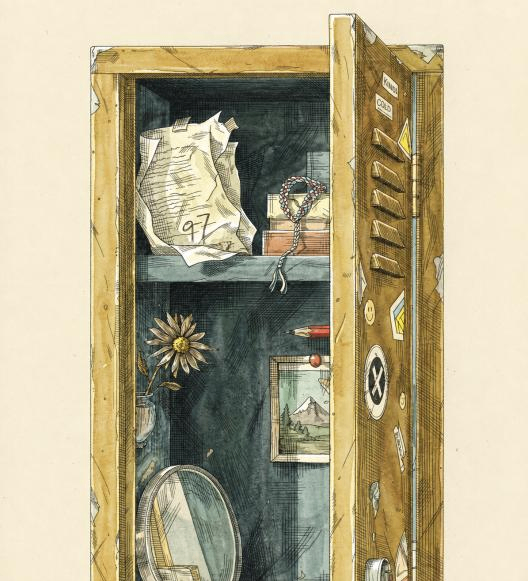
a crumpled essay
a friendship bracelet, frayed
a dried flower, a photograph
a pencil stub, a small mirror
all the selves I was today
the walls of this school
have absorbed more adolescent panic
than any structure should legally hold
and yet they stand
patient, plaster, unmoved
better therapists than any of us
· · ·
If the Common App didn't have a 650-word limit
• My greatest strength: closing 47 tabs without losing the one I actually needed.
• The person who influenced me most: the stray cat near the cafeteria dumpster, who taught me that dignity is a state of mind.
• My favorite word: “whatever,” the Swiss Army knife of responses — agreement, defiance, surrender, philosophy, depending on tone.
Admissions officers, please do not take this personally. Or do. We can't tell.
· · ·
Wisdom from people who can explain things in eighteen minutes
Trevor Noah, Commencement Address
“I used to think being a teenager meant you were just a beta version of a person. Then I realized adults are just teenagers who own printers and have given up on asking why the sky is blue.”
→ Honestly, fair.
Chimamanda Ngozi Adichie, The Danger of a Single Story
“The single story creates stereotypes, and the problem is not that they are untrue, but that they are incomplete.”
→ You are at least seventeen stories. Minimum.
Meg Jay, Why 30 Is Not the New 20
“Twenty-somethings are like airplanes just leaving LAX. A slight change in course is the difference between landing in Alaska or Fiji.”
→ At seventeen your plane is still being built, and the airport is on fire.
· · ·
Tina writes from the bathroom floor. Yuki learned in Tokyo to apologize to inanimate objects. Nadia embroiders in the margins and calls it “note-taking.” Sophia gets choked out twice a week and calls it “training.” Lin Wei talks to walls; the walls, reportedly, talk back.
Set in Times New Roman, because we don't have the budget for Adobe Caslon. © 2026. No rights reserved. Except the tea bowl.
· · ·
A pencil, taking root.
you're doing fine
even if you forgot your chem homework again.