


THE SENIOR THESIS(Excerpt)
The magazine's editor--Lily Xia, this episode's editor--Jason Wu from Students' English Editorial Office
A student-run magazine exploring the connections between people and society. From everyday experiences to broader social issues, the magazine looks at how our surroundings, relationships, and social expectations shape the way we think and live. Through articles, personal reflections, and discussions of real-world issues, it offers a space to question familiar ideas, explore different perspectives, and see ordinary life from a new angle.
VOL. 01 · GROWING UP
VOL. 02 · ON ENDINGS
VOL. 03 · THE OPTIONAL LIFE
VOL. 04 ·NO NEED TO BE BRAVE
VOL. 05 · ON COMING BACK
VOL. 06 · ON HERITAGE
VOL. 07 · SAME WORD, DIFFERENT THINGS
· · ·
VOL.01.GROWING UP · OCTOBER 2025
THE SENIOR THESIS
(QUIETLY)
A journal by juniors who pay attention to the wrong things

"For those of us allergic to answers."
THE SENIOR THESIS (QUIETLY) · VOL.01.GROWING UP
Cover: 'Girl with Open Textbook, Contemplating the Ceiling'
$0.00 · PRINTED ON PAPER RESCUED FROM THE RECYCLING BIN
· · ·
THE SENIOR THESIS
(QUIETLY) · OCTOBER 2025
What's Going On at School?
Staff A Week in Observation 3
On the Self
Tina The Physics of Frizz 4
Sophia The Philosophy of a Jiu-Jitsu Girl 5
Across Cultures
Yuki The Veins of a Tea Leaf 6
Nadia Grandmother's Stitches 7
Art & Space
Lin Wei The Echo of Walls 8
Illustration
Growing up 9
Words, Ideas & Expression
Various Found in Translation 10
Book Club What We're Reading 11
Various Hall Pass & Others 12
Staff The Honest Files 13
Something Lighter
Various TED Bites: Snack-Sized Wisdom 14
Staff Artists Spot Drawings 15
Contributors & Colophon
Staff Who Made This, and How 16
· · ·
ON THE SELF
By Tina, 11th Grade
The Physics of Frizz
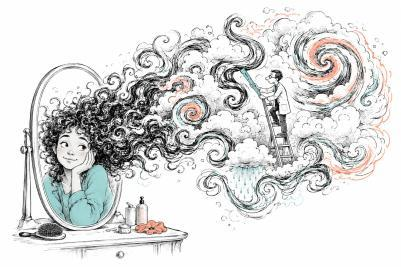
Illustration: 'A Fractal, Not a Flaw'
The first lesson was war. For fifteen years, my hair has been a chaotic rebellion against every brush, every weather forecast, every authority figure that tried to smooth it down. My mother called it 'unruly.' My grandmother called it 'a sign of character.' My science teacher, Mr. Chen, was the first to call it 'a teachable moment.'
He once wrote on the board, during a unit on fractals: 'Observe the geometry of nature. A coastline. A snowflake. Tina's hair.' The class laughed. I laughed too, because what else do you do when your hair becomes a whiteboard example? But that moment stayed with me. Because he was right. My hair is fractal. It is chaotic. It is, in its own way, an equation that refuses to be solved.
I grew up in a humid city, where the air itself seems to conspire against straight lines. Every morning I would stand in front of the bathroom mirror with a hair straightener, a weapon of daily surrender, and try to iron out the curls that had re-formed overnight like some kind of botanical uprising. My hair had its own agenda. It always did.
On Resistance
There is a particular kind of exhaustion that comes from fighting your own reflection. I remember being twelve and crying in the bathroom because no matter how many YouTube tutorials I watched, my hair refused to look like the girls in the videos. It refused to be 'sleek.' It refused to be 'effortless.' It was, in a word, itself.
My hair was the first thing I ever had to negotiate with. Not my parents. Not my teachers. My hair.
Eventually, I made a deal with it. I stopped straightening. I started scrunching. I learned the vocabulary , leave-in conditioner, diffuser, plopping, and somewhere in that process, I discovered something unexpected: the girls in the videos had curly hair too. They weren't trying to flatten it. They were trying to understand it.
Mr. Chen was right about the fractals. Each curl is a spiral, a miniature nautilus, a Fibonacci sequence you can hold in your hand. When you stop fighting the frizz and start looking at it, really looking, you see that what you thought was chaos is actually structure. It's just a structure that doesn't apologize for taking up space.
Aftermath
I still have bad hair days. Humidity remains undefeated. But I no longer cry in bathrooms. I have learned that some battles are not worth winning, and some wars are actually just conversations waiting to happen. My hair taught me this: the things we fight hardest are often the things we should simply learn to live with, perhaps even to love.
Last week, Mr. Chen passed me in the hallway and said, 'Your hair looks particularly fractal today, Tina.' I smiled and said, 'Thank you, sir. I've been working on my Koch snowflake.' He nodded, satisfied, and walked away.

A puddle catches the sky, indifferent to the sidewalk's cracks.
· · ·
VOL. 02 · ON ENDINGS · DECEMBER 2025
THE SENIOR THESIS
(QUIETLY)
A journal by juniors who pay attention to the wrong things
"For those of us allergic to answers."
THE SENIOR THESIS (QUIETLY) · VOL. 02 · ON ENDINGS
Cover: 'A door left slightly open'
$0.00 · PRINTED ON PAPER FROM THE RECYCLING BIN
· · ·
THE SENIOR THESIS
(QUIETLY) · DECEMBER 2025
What's Going On at School?
Staff A Week in Observation 3
On the Self
Hole The Last Time 4
Jan Three Months 5
Jason The Best Salad Maker I've Ever Seen Is My Third Uncle 6
Across Cultures
The Helsinki Bureau Finnish Lessons in Sisu (and Silence) 7
Staff Dept. of Absence 8
Art & Space
The Editors Eight Empty Frames (An Installation That Was Mostly Wind) 9
Illustration
On Endings 10
Words, Ideas & Expression
Various Found in Translation: How Other Languages Say Goodbye 11
Students Four Poems for the Long Light 12
Lily Talk About Your Death While You're Still Healthy 13
Something Lighter
Staff Artists Spot Drawings & Cartoons: On Parting 14
Various TED Bites: Three Ways to Leave a Room 15
Contributors & Colophon
Staff Who Made This, and How 16
· · ·
ON THE SELF
By Jan, 11th Grade
Three Months
“For my grandmother, who may have been a dream, and who is therefore harder to miss.”
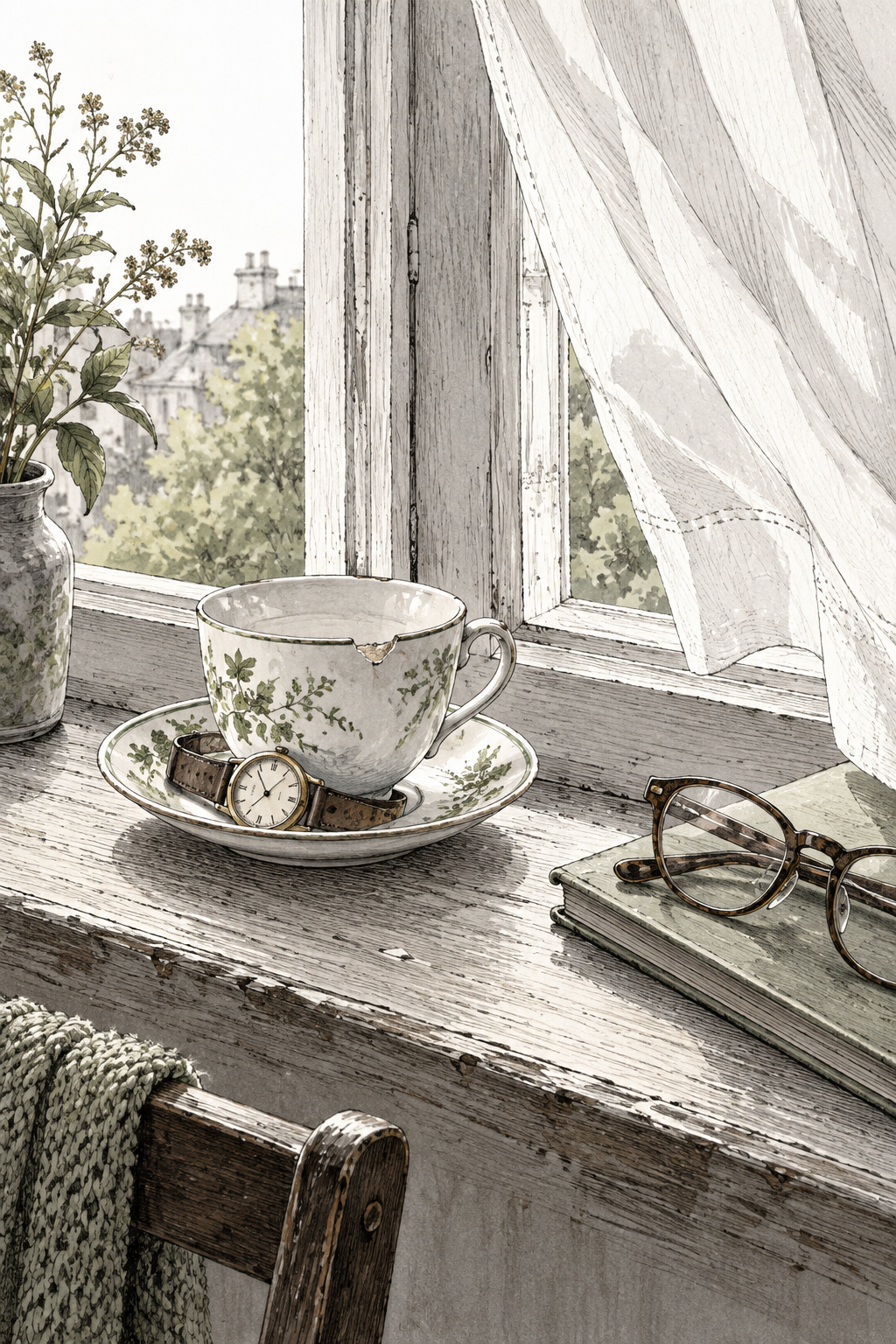
Illustration: 'The teacup, after.'
Ateacup touched the table. My grandmother was sitting by the window. My aunt was there, too. The curtain lifted now and then in the breeze, and someone was talking downstairs. Everything was where it should have been. So I did not ask why she was there. I did not cry or reach for her. I simply sat beside her and began telling her about my life, the way I always had.
“My summer break is three months,” I said.
“Three months?”
“Three whole months. I'll have plenty of time to stay with you.”
She smiled. I remember thinking how long three months sounded. Long enough to have breakfast together without counting the mornings. Long enough to sit around after dinner. Long enough for her to ask the same questions more than once and for me, perhaps, to answer them more patiently. Then I told her I had been accepted to a summer program at Peking University.
She did not really understand what a summer program was. She only heard Peking University. That was enough. She stood, leaned toward the open window, and called to an old friend passing below. “My grandson is going to Peking University!” I tried to correct her. “It's not exactly, ” But she had already started again. My aunt laughed and invited the woman upstairs. A chair was pulled out. Tea was poured.
My grandmother began telling my story as if it belonged partly to her, adding things I had never said, answering questions before I could. She had always been like this. As a child, I hated it. The moment she began telling relatives or neighbors about me, I would interrupt. “Grandma, that's enough.” She would smile and stop for a while. Then someone else would come along.
This time, I let her speak. I watched the movement of her mouth and the white hair near her temples. Sunlight rested on one side of her face. She looked pleased with herself. I remember thinking: Let her talk. There would be other chances to stop her. There were three months.
Then, slowly, I could no longer hear what she was saying. Her lips were still moving, but her voice seemed to come from farther away. The curtain blurred first, then the table, then her face. I tried to stay where I was. I opened my eyes. I knew I was awake, but I could not move. My arms felt separate from me. Something heavy sat on my chest.
I tried to speak, but no sound came out. There is an old Chinese expression for sleep paralysis: a ghost pressing down on the bed. But lying there, I did not think of ghosts. My body was in the present. My mind was still beside my grandmother. And only a few seconds earlier, I had been speaking to her about the future.
For a moment, the three seemed to overlap. The past sat by the window. The future was three months long. The present was whatever remained after I opened my eyes. I tried to fall asleep again. Not because I wanted to tell her the truth. I did not want to explain that those three months would never come. I did not want to tell her anything at all.
I have often misunderstood time. When I was younger, I thought there would always be another summer, another visit, another evening when nothing needed to be said because everyone would still be there tomorrow. Then a person dies, and tomorrow continues anyway, you graduate, you travel, good things happen, and sometimes, before you have finished being happy, you think of the person you would have told. She would have liked this. For that one hour, I did not miss her. There was nothing to miss. She was simply there, beside the open window, pleased that I had three months to give her. Sometimes I still wonder where they went. Perhaps they never existed. Or perhaps, somewhere beyond waking, she is still waiting for me to come home.
I keep the teacup. It is, by now, badly chipped. I have stopped noticing the chip. This, I have decided, is what we do with the things people leave behind: we do not preserve them perfectly. We just stop being able to see the damage. The cup holds water. The memory holds water. Neither is as whole as it once was, and both are, somehow, still exactly enough.
· · ·
VOL. 03 · THE OPTIONAL LIFE · FEBRUARY 2026
THE SENIOR THESIS
(QUIETLY)
A journal by juniors who pay attention to the wrong things
“For those of us still figuring out what forever means.”
THE SENIOR THESIS (QUIETLY) · VOL. 03 · THE OPTIONAL LIFE
$0.00 · PRINTED ON PAPER FROM THE RECYCLING BIN
· · ·
THE SENIOR THESIS
(QUIETLY) · FEBRUARY 2026
What's Going On at School?
Staff A Week in Which We Argued About Marriage 3
On the Self
Lily Forever? Maybe Later 4
Lily Home, Who Counts 5
Bin Family, as I See It 6
Across Cultures
Jone My Grandma's Wedding Photo 7
Linda When Marriage Becomes a “Project” 8
Yoyo Bride Price, Apartments, Matchmaking Corners 9
Art & Space
The Editors The Wall With Three Blank Faces 10
Illustration
The Optional Life 11
Words, Ideas & Expression
The Editors The Things We Get to Choose 12
Anonymous Three Pieces for the Ones We Live With 13
Something Lighter
Staff Artists On Not Performing (and Failing at It) 14
Various TED Bites: The Talks We Watch in the Back Row 15
Contributors & Colophon
Staff Who Made This, and How 16
· · ·
ACROSS CULTURES
By Jone, 10th Grade
My Grandma's Wedding Photo
Hung on the Wall Her Whole Life. She Never Smiled in It
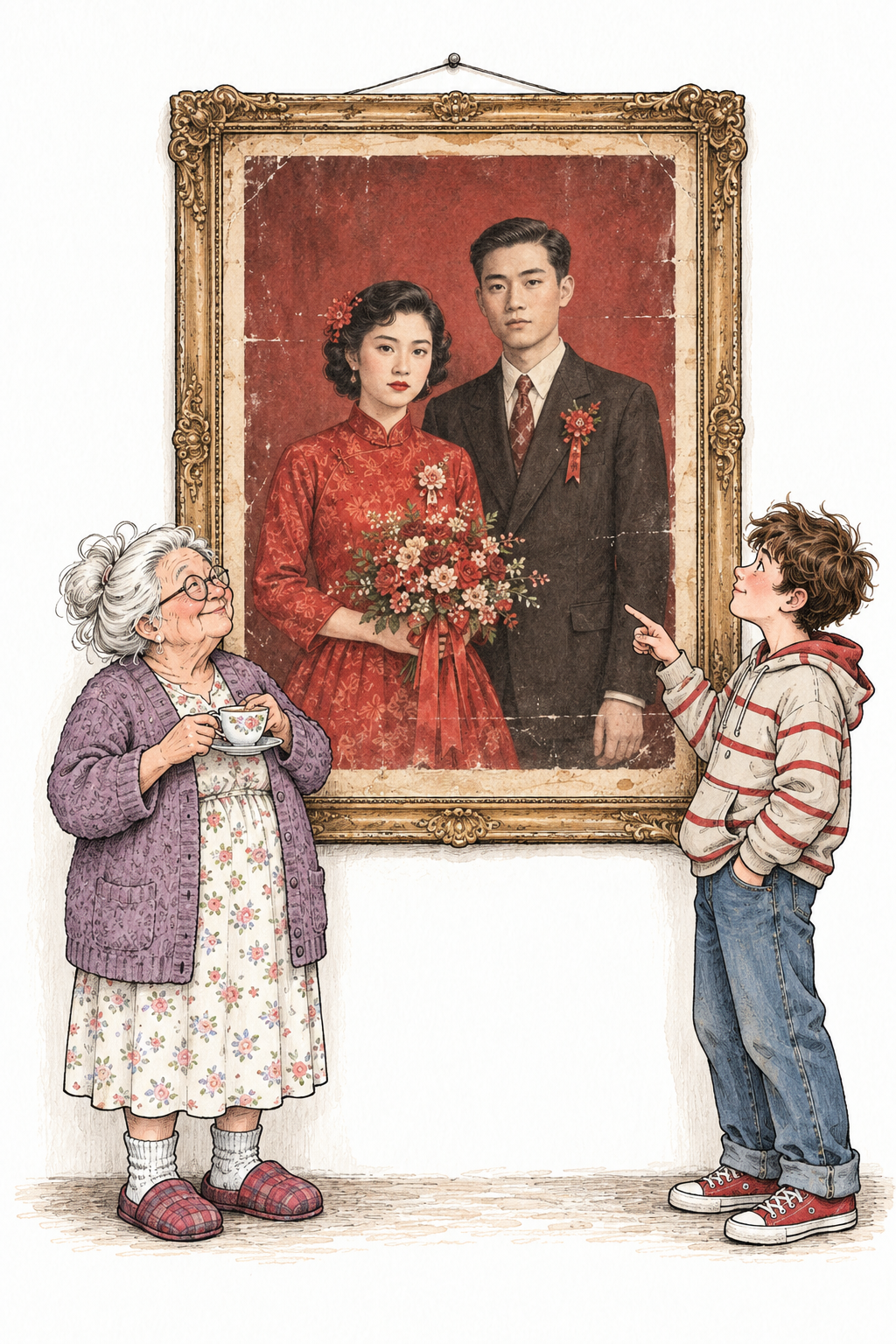
A grandma's story, a mother's bravery, and a choice for the future: never wait instead of myself.
There's a wedding photo hanging in my grandma's living room. Bright red backdrop. Two people sitting side by side. My grandma in a red dress, her lips painted a deep red.
She isn't smiling. When I was little I asked her, "Grandma, were you unhappy on your wedding day?" She said back then everyone posed that way. My grandma was born in 1958. She married my grandpa at nineteen. Arranged by a matchmaker. They met once, had a meal, and that was that. Her family was poor, four children, she was the second, a girl, and she stopped going to school after junior high. My grandpa drinks. Not every day, but once he starts, he doesn't stop easily. Then things get thrown. Cups. Chairs. He shouts in the yard in the middle of the night. My grandma would take my mom into the back room, close the door, cover her ears and wait for it to go quiet. My mom says what she feared most as a child was Chinese New Year. My grandpa would drink and make a scene, apologize afterward, and then do it all over again a while later. My mom says she can count on one hand the times she remembers my grandma smiling. She'd laugh when it was just the two of them, laugh when she took her to the market, laugh when my mom came first in class. But the moment my grandpa walked in, the smile was gone. One winter when I was ten, I went to stay at my grandma's over the holiday break. One night I woke up to a noise in the kitchen. I got up and looked. It was one in the morning. My grandma was washing dishes. My grandpa was in the back room watching TV, the volume turned up high. I went to the kitchen door and watched her. It was winter. No hot water. Her hands soaking in the cold. She didn't look up at me. She just said, "What are you doing up? Go back to bed." Later, when my mom and I talked about it, she went quiet for a long time. Then she said, "Your grandma spent her whole life waiting for other people. Waiting for her father to arrange a marriage. Waiting for your grandpa to sober up. Waiting for me to grow up so I could carry some of the weight. She never waited for herself." My mom divorced at thirty-two. She says my grandma sat on the sofa that day for an hour without saying a word. After a long time she said, "You're braver than I was." Whether I'll get married someday, I don't know. But one thing I do know: if I ever do, I need to be sure that person won't turn me into my grandma.
· · ·
VOL. 04 · NO NEED TO BE BRAVE · APRIL 2026
THE SENIOR THESIS
(QUIETLY)
A journal by juniors who pay attention to the wrong things
“For those of us who are tired of hiding it.”
THE SENIOR THESIS (QUIETLY) · VOL. 04 · NO NEED TO BE BRAVE
$0.00 · PRINTED ON PAPER FROM THE RECYCLING BIN
· · ·
THE SENIOR THESIS
(QUIETLY) · APRIL 2026
What's Going On at School?
Staff A Week in Which We Notice 3
On the Self
Lily She Walked into the Meeting Room with a Pad Hidden in Her Sleeve 4
Nill Blue Liquid 5
Across Cultures
Allia The Bottom Shelf 6
VOGUE “Menstruation”, A Word That Should Never Be a Source of Shame 7
Art & Space
The Editors The Bathroom as an Exhibition 8
Illustration
No Need to Be Brave 9
Words, Ideas & Expression
Lily Why Doesn't Public Space Provide for Us? 10
Nina When the “Good Stuff” Steps Out of the Dark 11
Staff Three Poems for the Blood We Don't Name 13
Something Lighter
Staff Artists Spot Drawings: On Not Hiding (and Failing at It) 14
The Editors TED Bites: The Talks We Watch in the Back Row 15
Contributors & Colophon
Staff Who Made This, and How 16
· · ·
ACROSS CULTURES
By Allia,11th Grade
The Bottom Shelf
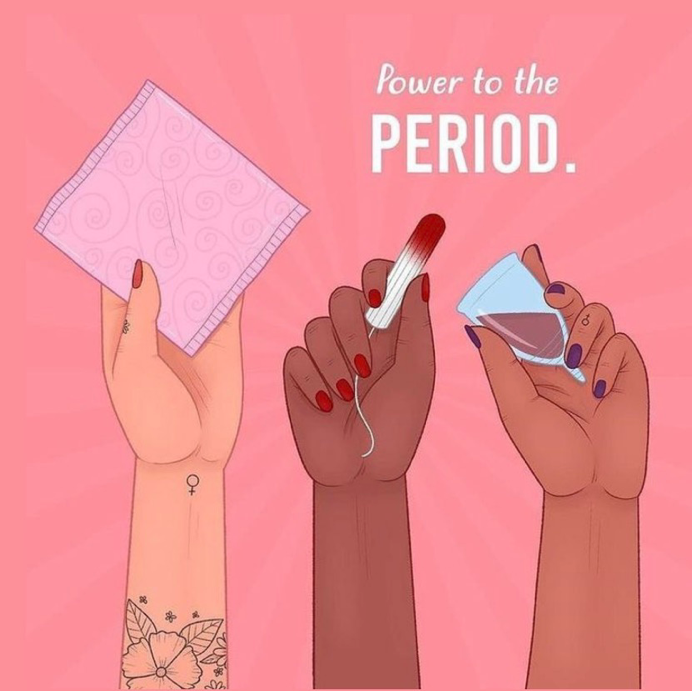
I ran an experiment. Two weeks, six supermarkets and convenience stores near school. I recorded where the pads were placed.
Store 1, convenience store by the school gate: bottom shelf. Razors to the left, condoms to the right. Shampoo and body wash on the two shelves above. The pads were sandwiched in between, like some sorting error. Store 2, supermarket by my housing complex: placed with baby diapers. Same row had nursing pads. The logic, I guess, was "anything involving bodily fluids." Store 3, underground supermarket in the mall: in the personal care section, but shoved in the farthest corner. Next to cotton swabs and band-aids. Pad packaging was uniformly pink, purple, white,

The bottom shelf, the corner, the secret inventory. Until someone decides to move it up.
soft colors, like they were saying "don't worry, we don't bite." Store 4, convenience store by the subway: no pads. I asked the clerk, he said "no, try the pharmacy across the street." The pharmacy had them. Next to the family planning section. Store 5, shop behind school: run by a woman. She keeps pads behind the counter, not on display. You have to ask her for them. She says "girls can come get them themselves," meaning don't let boys ask. But boys don't ask anyway. So the pads just sit behind the counter, like a secret inventory. Store 6, large chain store: the most complete row, most brands, most varieties. But blocked by a metal panel. A poster on the panel read "thoughtful care, private selection." You have to bend down to see the products themselves. Six stores. Not one placed pads at eye level. Not one. I went home and checked. Toothpaste is at eye level. Shampoo is at eye level. Snacks are at eye level. Condoms are at eye level, except Store 4. But pads, something over half the population uses every month, are on the bottom shelf, in the corner, behind the counter, behind a panel. I asked my mom: why can't pads be in a normal spot?
She said: it's just how it is. I said: just because doesn't mean it's right. She looked at me and said: when you grow up you'll understand, some things aren't about right or wrong, they're about whether it's worth the energy to change. I said: what if everyone thought that way? She didn't answer. Later I saw a video online. A girl moved pads from the bottom shelf to eye level in a supermarket, took a photo, posted it. Half the comments said "finally someone did it." The other half said "you're making everyone else uncomfortable." Uncomfortable. That word again. Something normal gets displayed, and people feel uncomfortable. I stood in front of Store 6's shelf, looking at those pads blocked by the metal panel. I reached out and pushed the panel up. Metal screeched. An auntie nearby glanced at me. I picked up a pack and placed it at eye level. Then I left. I don't know if they put it back. They probably did. But for one afternoon, it sat where it was supposed to.
· · ·
VOL. 05 · ON COMING BACK · JUNE 2026
THE SENIOR THESIS
(QUIETLY)
A journal by juniors who pay attention to the wrong things

“For those of us allergic to answers.”
THE SENIOR THESIS (QUIETLY) · VOL. 05 · ON COMING BACK
$0.00 · PRINTED ON PAPER FROM THE RECYCLING BIN
· · ·
THE SENIOR THESIS
(QUIETLY) · JUNE 2026
What's Going On at School?
Staff A Week in Observation 3
On the Self
Zia After Returning, You Become “Who You Used to Be” 4
Lily Five Blank Years on a Resume 5
Across Cultures
Dedao App How to Get Back to Work After a Career Break 6
Lucia Flexible Work: For Everyone, Except Everyone Who Matters 8
Shenzhen Window Shenzhen’s “Micro-Retirees” Are Lining Up to Get Back to Work 9
Art & Space
The Editors The Desk at the Back of the Room 10
Illustration
On Coming Back 11
Words, Ideas & Expression
The Editors How to Get Back to Work After a Career Break (TED Bites) 12
Students Three Poems for the Long Gap 14
Something Lighter
Staff Artists On Coming Back (and Leaving Again) 15
Contributors & Colophon
Staff Who Made This, and How 16
· · ·
ACROSS CULTURES
How to Get Back to Work After a Career Break
Source: Dedao App
So what did people who made it back do right? Research points to two paths.
Path one: turn the timeline into a total of experience. This is for people returning to the same field. Most resumes follow a template, a chronological line. Year to year, where you worked, what title you held.
Any gap jumps out immediately. But if you've got a gap, you need to reorganize that format into a "body of experience." List your capabilities by category: ten years of project management, eight years of large-scale event coordination. This isn't guesswork. In 2022, Columbia researchers published in Nature Human Behaviour a study using 9,022 real resumes. On resumes with gaps, they swapped the chronological format for a skills-based list. Callback rates went up significantly.
Path two: turn the "sequel" into an "upgrade." This is for people switching directions. Most people coming out of a break think one thing: get back on the old track. That's "sequel thinking", imagining your return as a movie sequel, same characters, same plot. But sequel thinking pits you against people who never left. You took two years off; the other candidate spent those two years climbing. Instead, try turning the sequel into an upgrade. First, translate what actually happened during the gap into capability language. Those experiences aren't blank space, they're unnamed skills. Naming them is step one. Then swap the question from "how far behind am I" to "which modules do I need to update."
A lot of return anxiety comes from asking the wrong question. Not "can I go back," but "where am I going, what's the gap between here and there, and how long will it take to close it." The first question creates anxiety, it's waiting for someone else to decide. The second triggers planning, it's designing your own next step.
Back to those numbers. LinkedIn found 60% of global employees have taken at least one career break. From this we might guess: careers are shifting from a straight line to a network. In the past, a career was a one-way track, leave it and you'd derailed. Today it's more like a transit map, with main lines, side routes, rest stops, and re-entry ramps. Lots of people will choose to "come back" at some point, back to full-time, back to a company, or pivoting somewhere new. The truly scarce skill might not be "staying in the game" anymore. It's "being able to come back anytime."
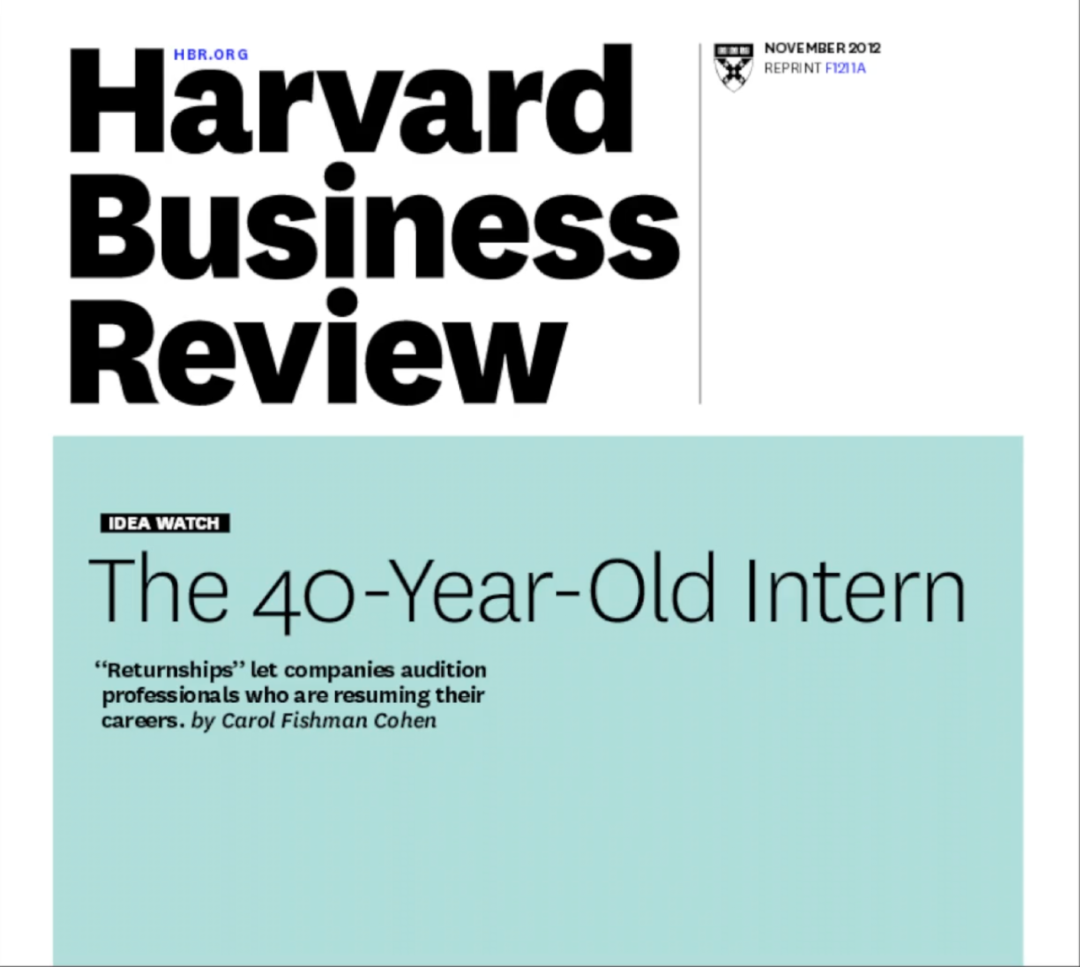
Experience does not expire during a career break.
· · ·
VOL. 06 · ON HERITAGE · AUGUST 2026
THE SENIOR THESIS
(QUIETLY)
A journal by juniors who pay attention to the wrong things
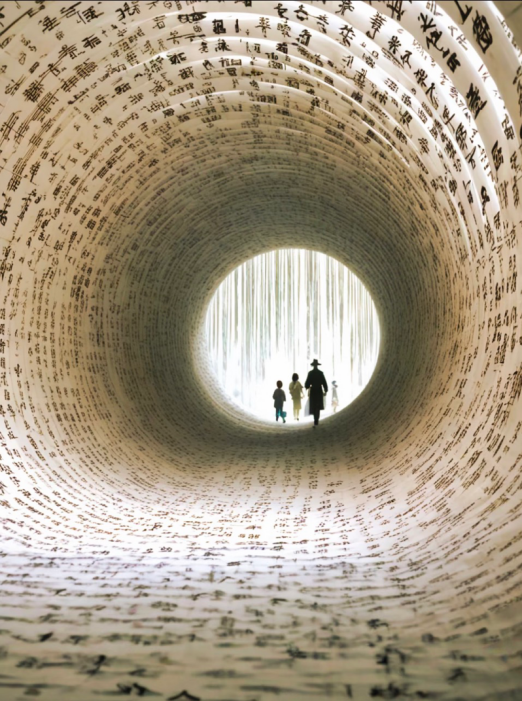
“For the things we inherit before we understand them.”
THE SENIOR THESIS (QUIETLY) · VOL. 06 · ON HERITAGE
$0.00 · PRINTED ON PAPER FROM THE RECYCLING BIN
· · ·
THE SENIOR THESIS
(QUIETLY) · AUGUST 2026
What's Going On at School?
Staff A Week in Which We Admit We Do Not Know 3
On the Self
Lin The First Drop of Indigo 4
Lily She Just Learned Embroidery on a Saturday Afternoon 5
Across Cultures
Ming Packing Patience Into the Bag of Youth 6
Hao What Happiness Looks Like 7
Art & Space
The Editors The Wall Between the Hands 8
Illustration
On Heritage 9
Words, Ideas & Expression
Mike The Brush 10
Students Three Pieces for the Things We Cannot Name 11
Something Lighter
Staff Artists On Not Knowing (and Pretending Otherwise) 12
The Editors TED Bites: Three Talks We Watch with the Sound Down 13
Su Yang When the Local Becomes the World 14
Contributors & Colophon
Staff Who Made This, and How 16
· · ·
ACROSS CULTURES
By Ming,a teacher
Packing Patience Into the Bag of Youth
In early spring, orioles vie for warm branches; swallows carry mud to build their nests." Suzhou in March breathes with life. Green trees line the roads, grass spreads like a carpet, a slow ink-wash scroll unrolling in real time. I walked those poetic streets and caught sight of an old shop tucked between newer buildings. Wooden frame, blue-stone walls, quiet elegance. A signboard read: Suzhou Ancient Printing Shop. Printing? Could this be the movable-type technique from the textbook lesson "The Movable Type"? Curious, I stepped inside.
The owner, a kind-faced middle-aged man, welcomed me warmly. I looked around. They had recreated the whole movable-type process. Tools, samples, everything was there. He saw my excitement and offered to let me try carving a type block. Carving looks simple. It isn't. He brought clay, kneaded and pounded it until smooth, shaped it into a flat square. Then he carved a reversed character directly into the wet clay, each stroke measured, deliberate. In his hands the knife moved like a general's blade. In moments, a sharp Spring character leapt onto the clay. My turn. The knife in my hand acted like a naughty child. It went everywhere I didn't want it to. The more anxious I got, the worse the strokes. Clay block after clay block, none worth keeping. Sweat rolled down my forehead. Frustration sat heavy on my chest.
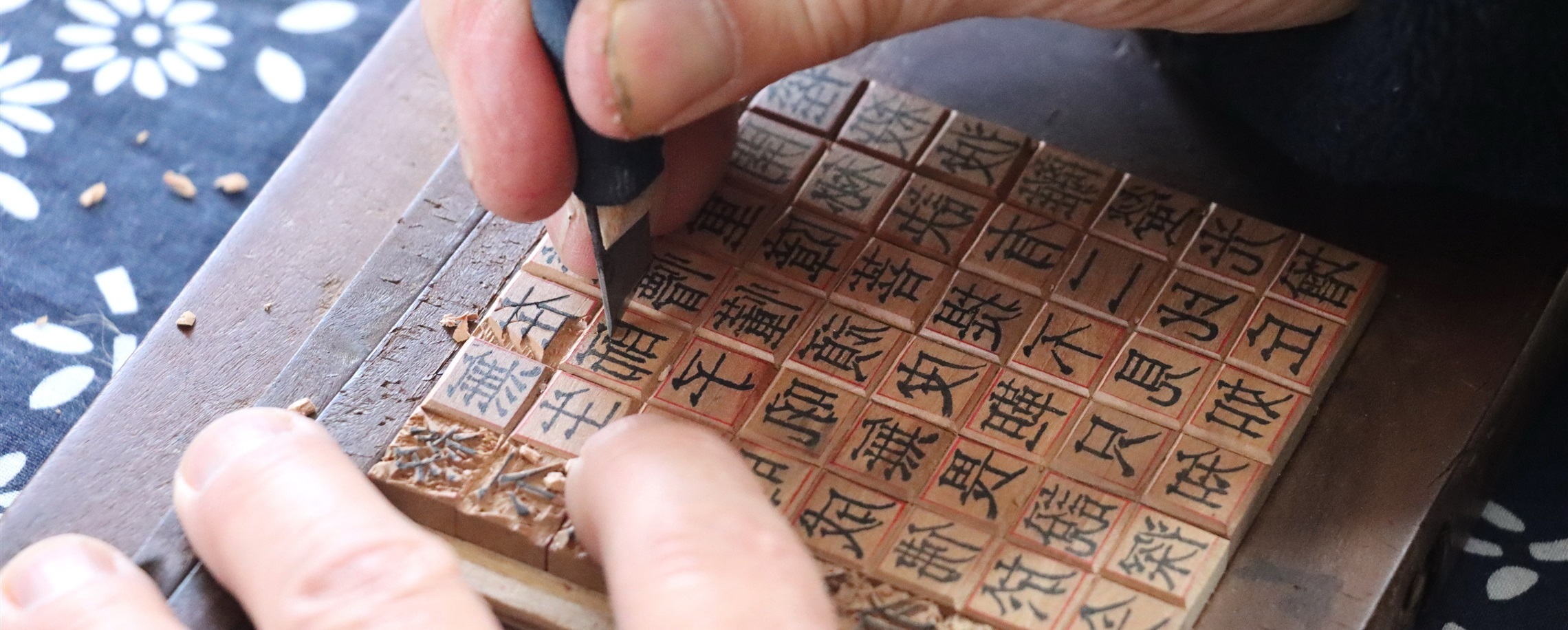
One cut at a time. Patience, made solid.
The owner patted my shoulder. "Young man, don't rush. With this work, patience matters more than skill. A lot in life is like carving, you can't force it." I breathed deep. Slowed down. One cut at a time. After several tries, I finished my first character. Not clean, not standard, but mine. I looked at it and knew: this was patience, made solid. That day I learned that patience isn't just a working attitude. It's a way of moving through life. On the road of youth, I want to sew patience tightly into my bag. Whatever hard problem comes next, I'll face it steady, one stroke at a time.
· · ·
VOL. 07 · SAME WORD, DIFFERENT THINGS · OCTOBER 2026
THE SENIOR THESIS
(QUIETLY)
A journal by juniors who pay attention to the wrong things
“For those of us still trying to say the same word.”
THE SENIOR THESIS (QUIETLY) · VOL. 07 · SAME WORD, DIFFERENT THINGS
$0.00 · PRINTED ON PAPER FROM THE RECYCLING BIN
· · ·
THE SENIOR THESIS
(QUIETLY) · OCTOBER 2026
What's Going On at School?
The Editors A Week in Which We Said the Same Word 3
On the Self
Huser No Reconciliation Required, Just Recognition 4
Across Cultures / On the Times
Lily Her Mom Doesn't Really Get Her. But That's Okay. 5
Life Stop Asking for My MBTI! 6
Max On Being New, Being Young, and Being Misread 7
Art & Space
The Editors The Wall Between the Words 9
Illustration
Same Word, Different Things 10
Words, Ideas & Expression
Tina How We Read the News 11
Chris The Price of Things We Don't Share 12
Anonymous Four Small Attempts at Translation 13
Something Lighter
Staff Artists Same Word, Different Things 14
The Editors TED Bites: Three Talks About Words That Miss Each Other 15
Contributors & Colophon
Staff Who Made This, and How 16
· · ·
ACROSS CULTURES / ON THE TIMES
By Lily, 12th Grade
Her Mom Doesn't Really Get Her. But That's Okay.
She can't remember the last time she and her mom actually had a long conversation.
It's not that they don't talk. They do, every day, “Did you eat?” “You're home.” “Go to sleep early.” These lines never get skipped. But once they're said, that's it. They feel more like checking that the other person is still there, still fine, rather than exchanging any real thoughts. And she knows this isn't just a them problem. A lot of families are like this, parents and kids living under the same roof, but not necessarily living in the same world. She used to really want her mom to understand her. Why someone would choose a gap year. Why sometimes she doesn't want to follow the path everyone calls “normal.” Why, even when there's a seemingly safer road right in front of her, she still hesitates. She tried explaining it properly, too. But every time she got halfway through, one look at her mom's face told her she probably wasn't getting through again. Then, slowly, she started to realize the problem might not be that someone wasn't listening hard enough. Her mom's generation simply has a different understanding of what it means to “live well.” School, a stable job, marriage, kids, step by step, forward. That way of living doesn't need much explaining, because most people around them lived it that way. But her generation? Suddenly there are so many choices. You can move cities, switch careers, work a few years later, start over. The road is no longer just one, it's many roads squeezed together. It sounds like freedom, but with too many options, sometimes you just end up not knowing which way you actually want to go. When she used to hear her mom say “stability is what matters most,” her first reaction was always that it was too conservative. Why does it have to be stable? Why can't you try something else? Why can't you take a road no one else has taken? Then one time, she thought about it from a different angle. If her mom grew up in a completely different environment, then maybe “stability” isn't just a word to her. Maybe it means finally not having to worry about tomorrow. Maybe it means once something is finally settled, you don't have to live in fear of it disappearing. She used to think her mom was just afraid of change. Now she's starting to understand, maybe it's precisely because her mom knows what change feels like that she holds onto stability so tightly. Thinking about it that way, she suddenly felt she didn't need to prove who was right anymore. They still don't understand each other, a lot of the time. When she talks about her ideas, her mom still frowns sometimes. When her mom talks about what she thinks “should” be done, she still feels a little helpless. None of that is going to vanish just because she had one small realization. But she doesn't really see it as a problem that needs solving anymore. They can not fully understand each other and still love each other. The way her mom sees the world is her mom's. The way she sees it is hers. They don't need to force two sets of answers into one. As long as they can find a way to be together that lets both of them be comfortable, that's good enough. Last week, she sent her mom a message. Nothing special. Just a photo she thought was really pretty. A little while later, her mom replied with a thumbs-up emoji. She stared at that tiny emoji for a while, and smiled. Before, she probably would've thought: what kind of communication is that? Now, she felt like maybe it was enough.
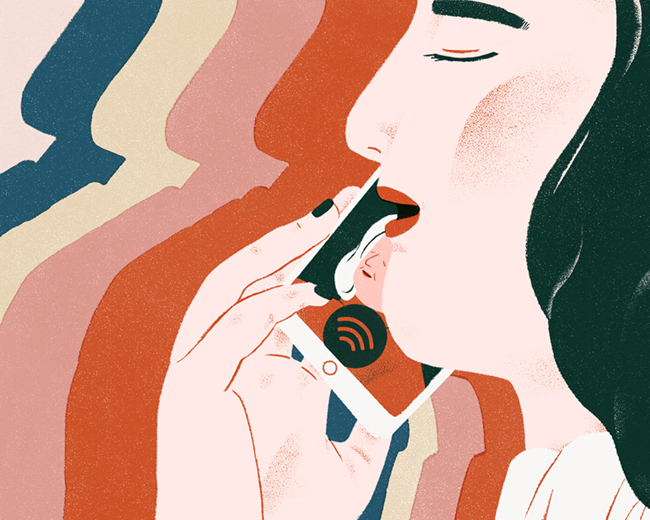
A message sent, a thumbs-up back. Not understanding, just presence.
· · ·